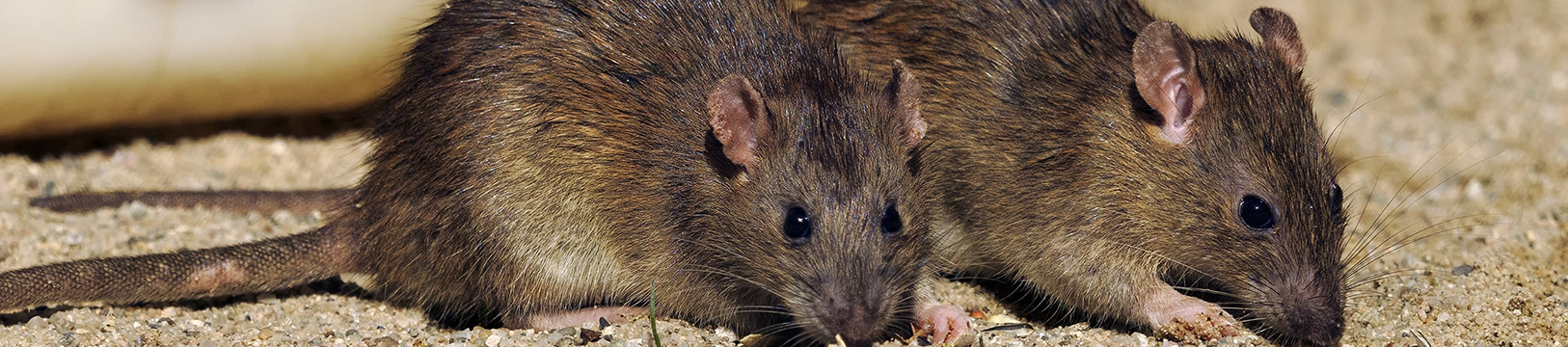
Norway rats (Rattus norvegicus), also known as brown rats or sewer rats, are common rodents in Ohio and can infest homes and businesses throughout Northeast Ohio. They have heavy, stocky bodies, blunt noses, small ears, and scaly tails that are shorter than the combined length of the head and body.
Around Akron, Cleveland, and the surrounding Northeast Ohio communities, Norway rats are most often associated with ground-level and below-ground areas. Outdoors, they commonly burrow near foundations, sheds, slabs, garbage areas, and other protected locations. Indoors, they are more likely to settle in basements, crawl spaces, garages, lower wall voids, and storage areas.
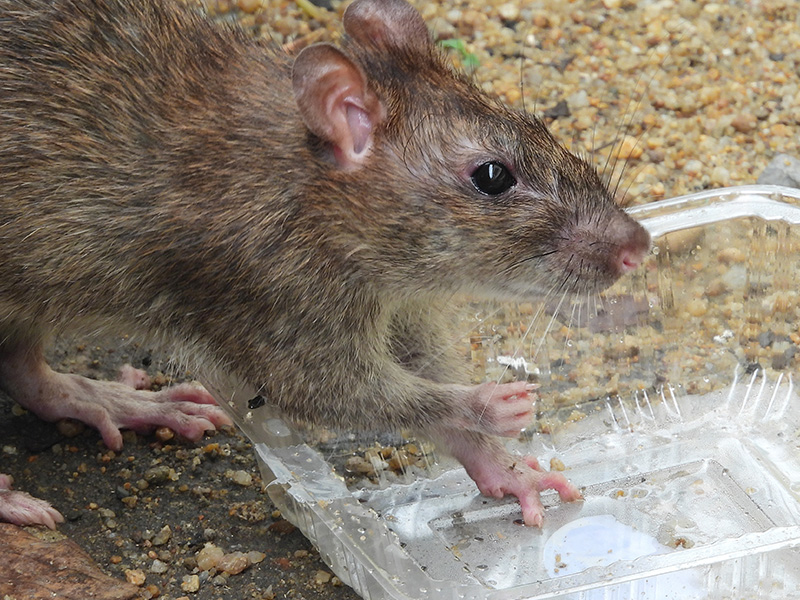
Norway rats are active year-round in Northeast Ohio, but they are often more noticeable from September through February as cooler weather increases their use of homes, basements, crawl spaces, garages, sewers, and other protected areas.
From March through August, activity is generally moderate rather than absent. Rats may continue to live and breed outdoors in burrows near foundations, slabs, garbage areas, and other sheltered locations, while established indoor populations can remain active in any season.
Norway rats are much larger and heavier than other house-infesting rodents. Adult Norway rats typically have:
Adults can weigh close to a pound, although size varies.
A stocky rat with a blunt nose, small ears, and a tail shorter than its head and body is consistent with a Norway rat.
Norway rats are closely associated with people and developed areas because homes, businesses, waste areas, and other structures can provide food, water, and shelter.
They are strong burrowers and generally stay closer to the ground than roof rats.
Outdoors, Norway rats may nest:
Indoors, they are more commonly found in:
Norway rats are capable climbers and can reach elevated areas, but ground-level and below-ground locations are more typical.
Norway rats can also squeeze through surprisingly small openings. Gaps roughly ¾ inch wide can be large enough for an adult rat to enter, and rats may enlarge weaker openings by gnawing.
Norway rats can sometimes be confused with large mice or other rat species.
Norway rats vs. mice:
Mice are considerably smaller and lighter. They have more delicate bodies and proportionally larger ears. Adult Norway rats are stockier, heavier, and have noticeably larger feet and droppings.
Norway rats vs. roof rats:
Norway rats are heavy-bodied rodents that usually stay close to the ground and commonly use burrows, basements, crawl spaces, and lower levels of buildings. Roof rats are slimmer, have proportionally longer tails, and are better adapted to climbing and nesting in elevated areas.
In Northeast Ohio, a heavy-bodied rat found around a basement, crawl space, foundation burrow, garage, or other ground-level area is more consistent with a Norway rat than a roof rat.
Norway rats look for three basic things: food, water, and shelter.
Common attractants around homes and businesses include:
Developed areas can support rat activity because food and shelter may be available across multiple neighboring properties. Rats may move between homes, alleys, commercial areas, sewers, landscaping, and other nearby sources of food or cover.
Many signs of Norway rats overlap with those of mice and other rats. The combination of larger droppings, ground-level burrows, noticeable gnaw damage, and activity around basements, crawl spaces, foundations, and lower levels of a building is more consistent with Norway rats.
Common signs include:
Ground-level burrows and larger rat-sized droppings are among the stronger clues that the activity may involve Norway rats.
Norway rats can create both health and property concerns around homes.
They can:
Rodent-contaminated materials should be handled carefully. Dry sweeping or vacuuming rodent droppings can stir contaminated particles into the air, so appropriate cleanup procedures should be followed.
Norway rats also reproduce quickly when food, water, and shelter are readily available. An established population can grow if the conditions supporting it are not addressed.
Reducing food, shelter, and entry points can make a property less favorable to rats.
Helpful steps include:
Exclusion is especially important because removing rats without correcting the openings and conditions that support them can allow activity to continue.
If you see a Norway rat or find signs that rats are active around your home, it is best to bring in a professional right away. Rats can be difficult to eliminate once they settle in, and the longer they stay, the greater the chance of contamination, damage, and a growing infestation.
A professional can confirm where the rats are active, find likely entry points, and recommend the right way to control the problem.
Epcon Lane’s residential pest control plans include rats among the covered pests and provide exterior rodent baiting along with ongoing pest protection. If you are seeing rats or finding signs of activity around your home, our team can help determine the appropriate level of protection for your property.
We also provide commercial pest control for businesses dealing with rodent activity throughout Northeast Ohio.
If Norway rats are showing up around your property, contact Epcon Lane to request a free quote.
The name is misleading. Norway rats are not native to Norway. The name is generally traced to 18th-century naturalist John Berkenhout, who believed the species had reached England on ships from Norway. That assumption was incorrect; the species is thought to have originated in Asia.
Not necessarily, but seeing one should be taken seriously. A single sighting cannot tell you how many rats are present, and Norway rats are often active when people are not around. Checking for additional signs and addressing the activity promptly is the safer approach.
Yes. Norway rats can live and travel through sewer systems, where they may find water, shelter, and food. They also commonly live in outdoor burrows and around buildings, so seeing a Norway rat does not necessarily mean it came from a sewer.

Today was the first time Epcon Lane came out to service our home and John was awesome! He was very friendly, professional and personable. We're very happy with our decision to go with this company and can't wait for our future services!
Allie W.
Akron, OH

Matt was fantastic. Explained all options and was very thorough and friendly. Really like that they guarantee their work and will come back between spraying for any issues. These guys are top notch!
Jason L.
Cleveland, OH

I have always been pleased with the service I have received from Epcon Lane . Very effective and environmentally and pet conscious. Kermin truly addressed my needs yesterday . Seeing the new nest of yellow jackets and the carpenter ants starting to lay eggs . Gave the proper treatment and sent a very detailed message explaining everything. And wished me a good rest of my day. I am very appreciative!
Margaret G.
Akron, OH






Helpful Tips & Info