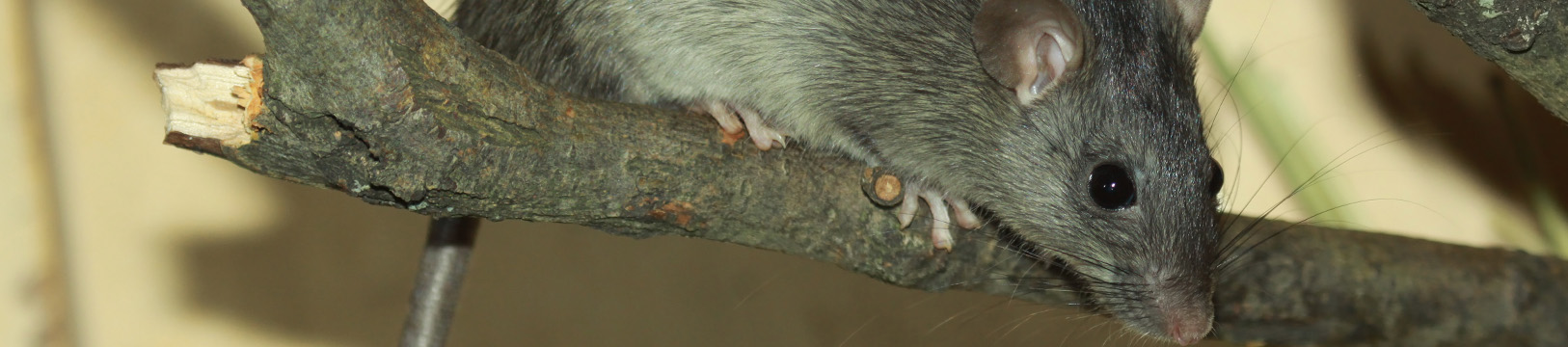
Hearing movement above the ceiling at night can be unsettling. Roof rats are agile rodents that prefer elevated nesting areas, making attics, wall voids, soffits, and other hard-to-reach spaces especially attractive.
Although roof rats are most established in warmer coastal and southern regions, proper identification remains important whenever rat activity is suspected.

If roof rats are present, outdoor activity around Northeast Ohio properties is expected to be lowest from December through February, increase during March and April, and remain highest from May through October. Activity typically declines in November as temperatures fall. However, roof rats living inside heated homes and buildings can remain active throughout the year.
Roof rats have several distinguishing characteristics:
Roof rats, also known as black rats or ship rats, are climbing rodents that live closely alongside people. Scientifically known as Rattus rattus, they are a nonnative commensal species that has adapted to living in and around human-built environments.
Roof rats and Norway rats can cause similar problems, but their appearance and nesting habits are different.
Roof rats are slimmer than Norway rats, with pointed muzzles, larger eyes and ears, and tails that extend beyond the combined length of their heads and bodies. They also favor elevated nesting areas, while stockier, blunt-nosed Norway rats are more likely to burrow or occupy lower levels.
Young rats may also be mistaken for mice. Correct identification matters because trap placement, entry-point inspections, and control strategies vary by species.
Roof rats are omnivores, but they often favor plant-based foods such as:
They may also feed on insects, bird eggs, food waste, and other readily available materials. Outdoors, damaged or hollowed fruit and gnawed nuts can indicate roof rat activity.
Roof rats that reach a home may enter through gaps around:
Overhanging branches and climbing vegetation may provide additional routes to the roofline.
Roof rats tend to remain hidden, so property owners often notice evidence before seeing a live rat.
Common signs include:
Droppings can provide a useful clue, but their appearance alone may not reliably identify the rodent species.
Inside buildings, roof rat activity is most likely to appear in elevated or concealed areas, including:
Around the exterior, signs may appear near dense vegetation, fruit or nut trees, bird feeders, pet feeding areas, garbage containers, and branches touching or hanging over the roof.
Roof rats can affect both the condition of a property and the health of the people living or working inside it.
Concerns include:
Rodents can spread pathogens through bites, scratches, contaminated food, or contact with urine, feces, saliva, and infested materials. Diseases associated with rodents include salmonellosis, leptospirosis, and rat-bite fever.
Roof rats can produce several litters in a year, with as many as eight young in a litter. Because their populations can grow quickly, early action can help limit the extent of an infestation.
Property owners can make homes and yards less accessible or attractive to roof rats by:
Exclusion—closing the openings rodents use to enter—is an important part of long-term prevention.
At Epcon Lane, we help homeowners throughout Northeast Ohio identify rodent activity, locate likely entry points, and determine the right level of protection for their property.
Our home pest control plans cover rats and include exterior rodent baiting as part of ongoing pest protection. The specific recommendations for your home will depend on the rodent involved, where activity is occurring, and the conditions around the property.
If you’re hearing movement overhead or finding signs of rats, don’t wait for the damage to spread. Contact Epcon Lane to have the activity evaluated and take the next step toward protecting your home.
No. Roof rats frequently occupy attics and ceiling voids, but they may also nest in wall voids, cabinets, trees, dense shrubs, vines, and other protected spaces above the ground.
Roof rats are mostly active at night, often beginning their search for food shortly after sunset. Daytime activity can occur, however, particularly when food is scarce, nesting areas are disturbed, or competition is high.
Accessible food, water, shelter, and climbing routes can all contribute to roof rat activity. Fruit, nuts, birdseed, pet food, garbage, dense vegetation, leaking water sources, and branches near the roofline may make a property more attractive or accessible.
Roof rats are unlikely to leave while reliable food, water, shelter, and entry points remain available. Addressing only the rats that are visible may not resolve nesting activity or prevent others from entering.
Yes. Epcon Lane provides customized commercial pest control for facilities throughout Northeast Ohio, including solutions for rodent activity.

Today was the first time Epcon Lane came out to service our home and John was awesome! He was very friendly, professional and personable. We're very happy with our decision to go with this company and can't wait for our future services!
Allie W.
Akron, OH

Matt was fantastic. Explained all options and was very thorough and friendly. Really like that they guarantee their work and will come back between spraying for any issues. These guys are top notch!
Jason L.
Cleveland, OH

I have always been pleased with the service I have received from Epcon Lane . Very effective and environmentally and pet conscious. Kermin truly addressed my needs yesterday . Seeing the new nest of yellow jackets and the carpenter ants starting to lay eggs . Gave the proper treatment and sent a very detailed message explaining everything. And wished me a good rest of my day. I am very appreciative!
Margaret G.
Akron, OH






Helpful Tips & Info