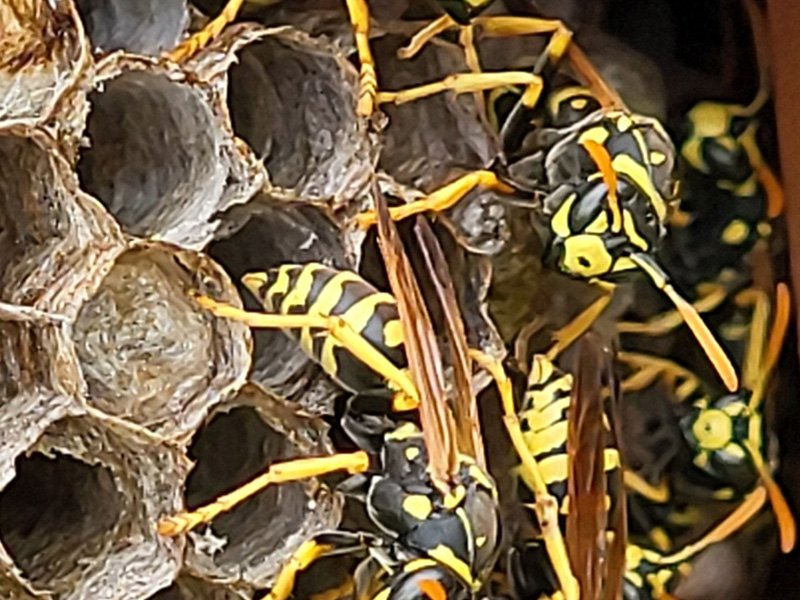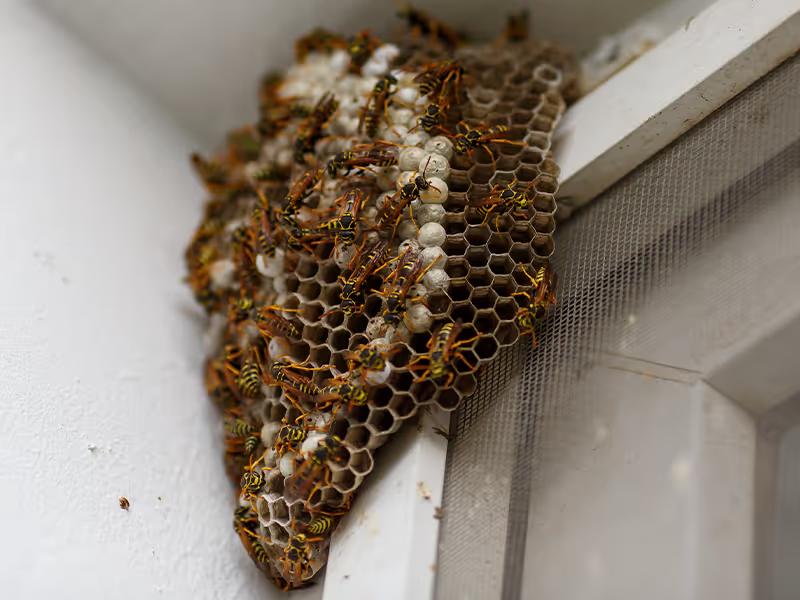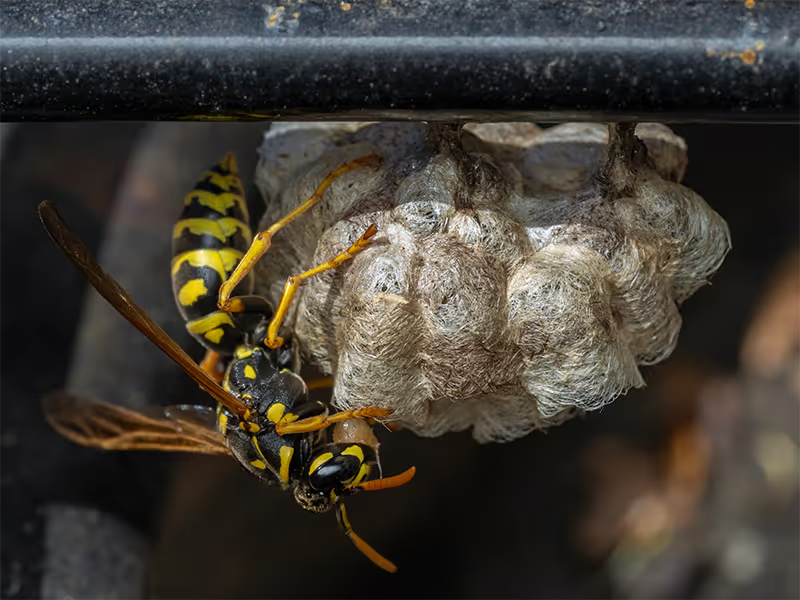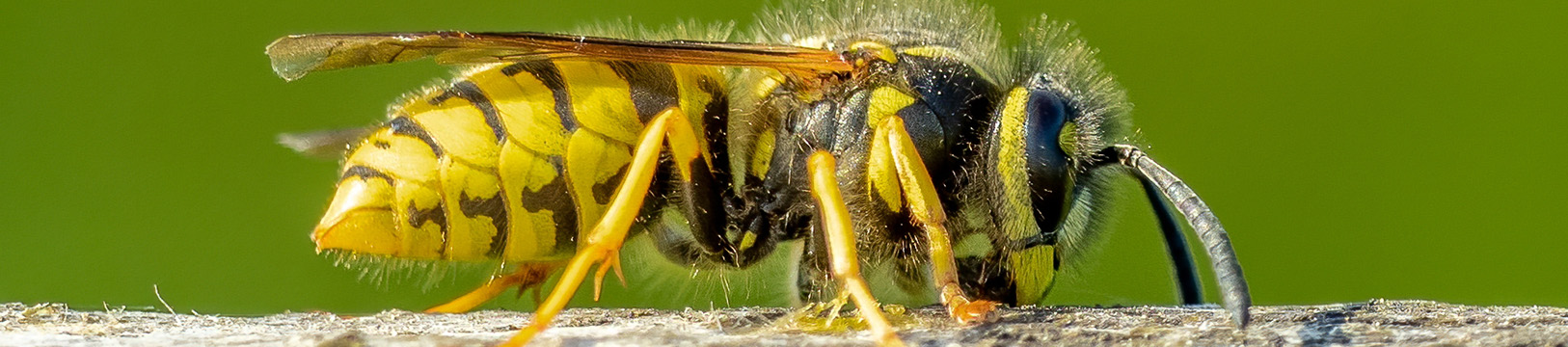
Yellow jackets are common stinging insects around homes in Northeast Ohio during the warmer months, where they may nest in lawns, landscaping, structural voids, trees, and shrubs.
If you see black-and-yellow wasps flying low and repeatedly disappearing into the same spot in the ground, there’s a good chance a yellow jacket nest is nearby.
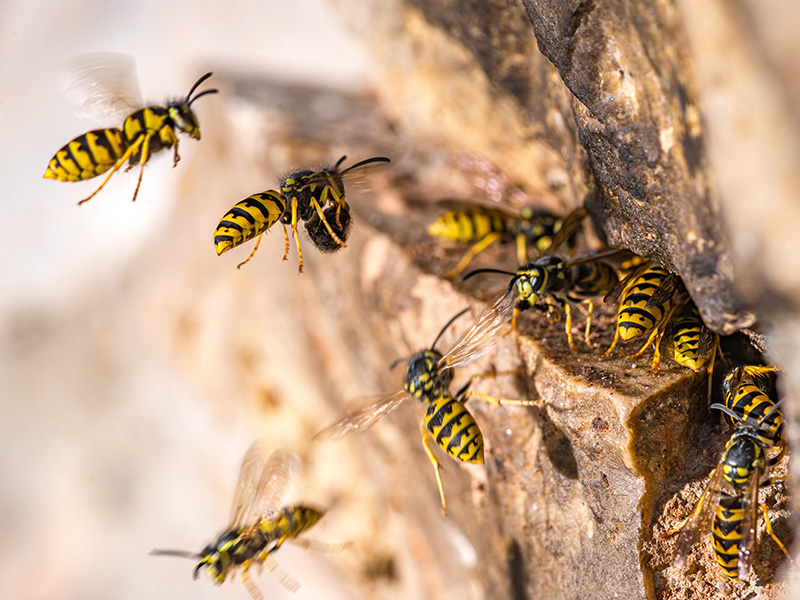
Yellow jacket activity begins in spring when overwintered queens emerge and start new nests. Colonies grow through early and midsummer, with activity typically peaking in August and September when nests may contain thousands of workers.
Late summer is also when yellow jackets become more noticeable around sugary foods, drinks, fruit, and trash. Activity declines as temperatures cool, and only newly mated queens survive the winter to start new nests the following spring.
Not sure what you’re dealing with? Yellow jackets have a few useful identifying traits:
Color alone is not always enough for identification, since some bees and other wasps also have black-and-yellow markings.
Yellow jackets are social wasps in the family Vespidae. Each colony begins in spring when an overwintered queen chooses a nest site, builds the first cells, and raises her first group of workers.
Once those workers mature, they take over food gathering, nest expansion, care of developing larvae, and colony defense while the queen focuses on laying eggs.
Yellow jackets also play a useful role outdoors. Workers capture caterpillars, sawfly larvae, and other insects to feed developing larvae. Problems usually begin when a colony develops near people or in areas around a home that are used regularly.
Ohio is home to several yellow jacket species. Those homeowners may encounter:
Northeast Ohio properties can offer yellow jackets both protected places to build colonies and plenty of food nearby. Lawns, mature landscaping, wooded areas, and structures with sheltered gaps or cavities can all create opportunities for yellow jacket activity.
They also become much more noticeable around homes later in the summer. Fallen fruit, uncovered trash, sugary drinks, and outdoor meals can attract workers searching for carbohydrate-rich foods.
Seeing yellow jackets around food does not necessarily mean a nest is nearby. Repeated activity around one specific area or opening is a stronger reason to take a closer look.
Nest location varies by species, and the colony itself is not always easy to see.
Common nesting sites include:
When yellow jackets are nesting inside part of a home, the opening you see outside may simply be the route workers are using to reach a nest farther inside.
Common signs homeowners may notice include:
A few yellow jackets visiting a patio, garden, or trash can may simply be foraging. Repeated traffic into and out of one specific opening is a stronger indication that a colony is nearby.
Yellow jackets become a concern when a colony develops close to places people regularly use.
Workers defend the nest and can sting repeatedly. That makes accidental encounters more likely when nests are near lawns, walkways, entrances, patios, play areas, or landscaping that needs regular mowing and maintenance.
The risk is especially important for anyone with a known allergy to stinging insects.
You cannot prevent every yellow jacket from flying through your yard, but a few steps can make the areas around your home less attractive and reduce opportunities for problems:
These steps may help reduce scavenging activity and opportunities for new colonies. They will not eliminate a nest that is already established.
Professional yellow jacket control is worth considering when a nest poses a stinging risk or is located in a difficult-to-reach area.
That includes:
Structural nests require extra care because the visible opening may not be where the colony itself is located. An active wall-void entrance should not simply be sealed shut. Yellow jackets may search for another route out and can move farther into the building.
Family-owned and operated since 1945, Epcon Lane helps homeowners in Cleveland, Akron, and throughout Northeast Ohio with stinging insect problems.
Epcon Lane's Peace of Mind home pest control plans include quarterly pest treatments, exterior service, interior service as needed, and wasp nest treatment for nests up to 20 feet.
If you’ve found a yellow jacket nest around your home or are seeing activity in an area your family regularly uses, contact Epcon Lane. We can evaluate the problem and recommend the right treatment for your property.
Yes. Unlike honey bees, yellow jackets do not leave their stinger behind after a sting. A worker can sting more than once, particularly when defending the nest.
Bald-faced hornets belong to the same genus as aerial yellow jackets, but they look quite different. They are larger, have black-and-white markings rather than black and yellow, and build enclosed paper nests above ground in trees, shrubs, or on structures.
Despite the name, a bald-faced hornet is not a true hornet. European hornets are true hornets and are also found in Ohio.
Move away from the area and avoid continuing to mow or trim near the entrance. Ground-nesting yellow jackets can become defensive when their nest is disturbed.
Yellow jackets do not damage wood like termites or carpenter ants. However, nests inside wall voids or other structural spaces can create problems if wasps find their way indoors.

Today was the first time Epcon Lane came out to service our home and John was awesome! He was very friendly, professional and personable. We're very happy with our decision to go with this company and can't wait for our future services!
Allie W.
Akron, OH

Matt was fantastic. Explained all options and was very thorough and friendly. Really like that they guarantee their work and will come back between spraying for any issues. These guys are top notch!
Jason L.
Cleveland, OH

I have always been pleased with the service I have received from Epcon Lane . Very effective and environmentally and pet conscious. Kermin truly addressed my needs yesterday . Seeing the new nest of yellow jackets and the carpenter ants starting to lay eggs . Gave the proper treatment and sent a very detailed message explaining everything. And wished me a good rest of my day. I am very appreciative!
Margaret G.
Akron, OH






Helpful Tips & Info