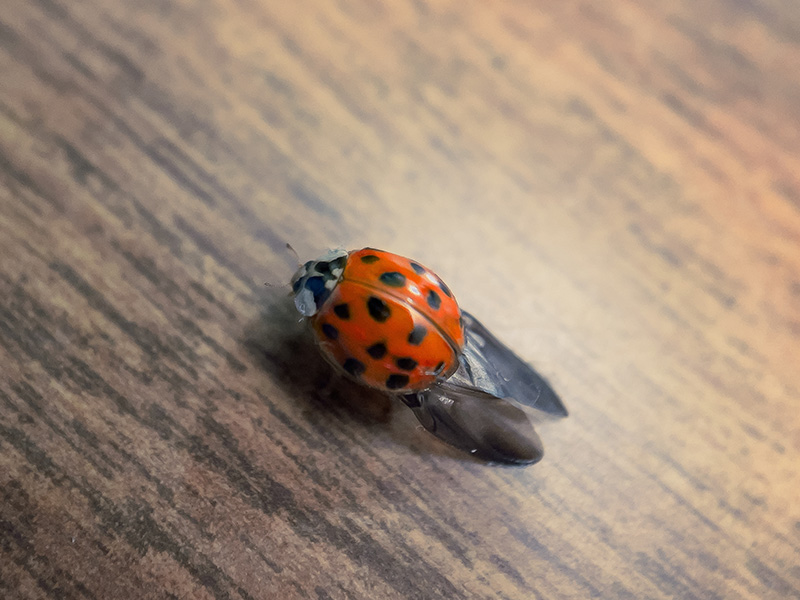
Multicolored Asian lady beetles (Harmonia axyridis), often shortened to Asian lady beetles, are a nonnative species originally from Asia that is now common in Northeast Ohio. Like other lady beetles, they are often called “ladybugs.”
Sometimes called Halloween lady beetles because they become especially noticeable in October, they spend much of the year outdoors feeding on aphids and other small insects. In the fall, they often move toward buildings to find protected places to overwinter.
Asian lady beetle problems around Northeast Ohio homes are most noticeable in fall, especially October and November, when beetles gather on buildings and look for places to overwinter.
Activity is usually low in January and February, then picks up again in March and April as overwintering beetles become active and move outdoors. During late spring and summer, they are primarily active outdoors and less likely to be household pests.
Multicolored Asian lady beetles can vary considerably in appearance, which is one reason homeowners sometimes have trouble identifying them.
Look for these characteristics:
Color and the number of spots alone aren't reliable ways to identify this species because individual beetles can look quite different.
Multicolored Asian lady beetles belong to the lady beetle family, but they aren't the only lady beetles found in Ohio.
One of the most useful identification clues is the pale area directly behind the head, which commonly contains a dark M- or W-shaped marking.
Their behavior around buildings is another clue. Multicolored Asian lady beetles are particularly well known for gathering in large numbers on homes in the fall and moving into cracks, wall spaces, attics, and other protected areas to overwinter.
They aren't gathering because your home is dirty or because they've found food indoors.
As temperatures begin to fall, multicolored Asian lady beetles look for sheltered places where they can survive the winter. Homes can provide the protection they seek, which is why large numbers may suddenly appear on exterior walls, windows, and other surfaces in October and November.
Some homes attract much heavier activity than neighboring properties, and the number of beetles can vary considerably from year to year.
Fall activity can be especially noticeable on exterior walls warmed by the sun.
That can leave homeowners with dozens or even hundreds of beetles crawling across siding, trim, windows, and doors during warm fall afternoons. From there, the beetles look for small openings where they can settle in for winter.
If beetles make it into wall voids, attics, or other sheltered areas, individual beetles may continue appearing indoors months later.
Once Asian lady beetles gather on a home, they can slip through very small openings that lead into protected areas.
Common entry points include gaps around:
Many remain hidden in wall voids, attics, and other sheltered spaces rather than moving immediately into living areas. That's why beetles seen indoors in winter or early spring may have actually entered the structure months earlier.
A sunny winter day can warm parts of a house enough to make overwintering beetles active.
Some then move toward light and warmth and accidentally enter living areas. Homeowners may find them crawling around window frames, walls, ceilings, and light fixtures.
This does not mean Asian lady beetles are reproducing inside the home. The beetles appearing during winter generally entered the structure months earlier to overwinter.
Multicolored Asian lady beetles are primarily a nuisance pest.
They don't eat wood, damage structural materials, chew fabrics, or infest stored food while overwintering indoors.
They can still cause problems when present in large numbers. When disturbed or crushed, Asian lady beetles can release a yellowish, strong-smelling defensive fluid. This can leave stains on some walls, fabrics, curtains, and other light-colored surfaces.
For that reason, crushing beetles against indoor surfaces isn't recommended.
Asian lady beetles do not sting.
They can occasionally pinch exposed skin, particularly when large numbers are present. They are not known to transmit disease to people.
Fall exclusion is the best way to reduce the number of Asian lady beetles that make it indoors. Before beetles begin gathering on homes in October and November, homeowners can seal gaps around windows, doors, siding, exterior trim, utility openings, vents, soffits, and other areas that may lead into wall voids or attics. Once beetles have already moved into protected spaces for the winter, sealing those openings will not remove the ones already inside.
A few Asian lady beetles near a window are different from hundreds gathering across the exterior of your home every fall.
Because these beetles move toward buildings seasonally and can enter through numerous small openings, timing is an important part of managing the problem.
Epcon Lane serves homeowners in Akron, Cleveland, and communities throughout Northeast Ohio. Asian lady beetles are among the beetles covered by Epcon Lane's home pest control plans.
If Asian lady beetles are covering your home in the fall or repeatedly appearing indoors, contact Epcon Lane to request a free quote.
Generally, no. Asian lady beetles are predators rather than typical plant-feeding pests. Both adults and larvae feed on aphids and other small, soft-bodied insects, which can make them beneficial in gardens and landscapes.
Yes. Vacuuming is one way to remove Asian lady beetles that have entered living areas. Avoid crushing them, since disturbed beetles can release a strong-smelling yellowish fluid that may stain some surfaces.
Problems are uncommon, but Asian lady beetles can release defensive chemicals that may irritate a pet’s mouth if several beetles are chewed or become trapped there. Contact your veterinarian if your pet has beetles stuck in its mouth, excessive drooling, or obvious oral irritation.

Today was the first time Epcon Lane came out to service our home and John was awesome! He was very friendly, professional and personable. We're very happy with our decision to go with this company and can't wait for our future services!
Allie W.
Akron, OH

Matt was fantastic. Explained all options and was very thorough and friendly. Really like that they guarantee their work and will come back between spraying for any issues. These guys are top notch!
Jason L.
Cleveland, OH

I have always been pleased with the service I have received from Epcon Lane . Very effective and environmentally and pet conscious. Kermin truly addressed my needs yesterday . Seeing the new nest of yellow jackets and the carpenter ants starting to lay eggs . Gave the proper treatment and sent a very detailed message explaining everything. And wished me a good rest of my day. I am very appreciative!
Margaret G.
Akron, OH






Helpful Tips & Info