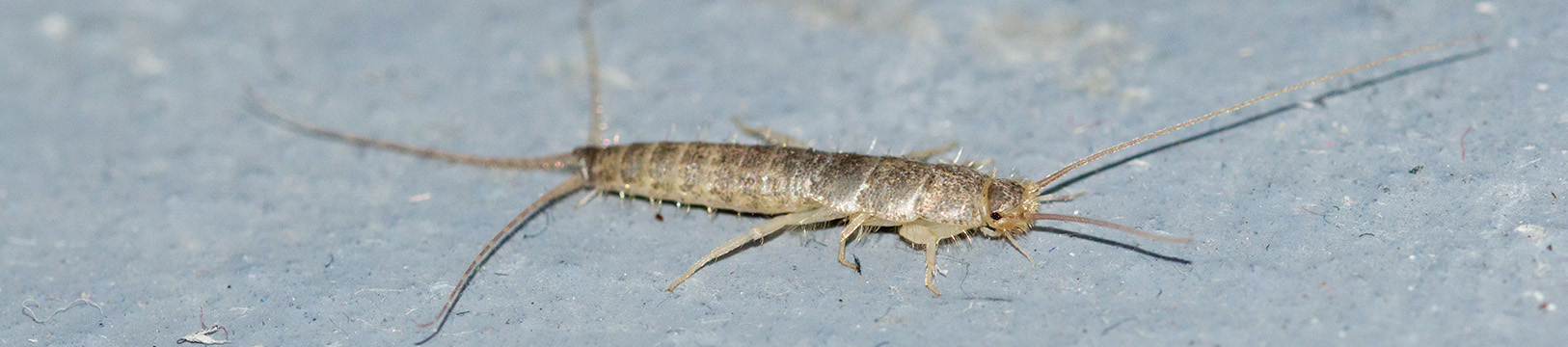
Most people don't know they have silverfish until one darts across the bathroom floor at night, or they find small holes in a stored cardboard box. Silverfish are small, fast, and active after dark, so a population can build for months before anyone notices it.
They're common in older homes across Akron, Cleveland, and the surrounding communities. They don't bite or threaten your health, but over time, they can damage stored items, which is the real reason to keep their numbers down.
Silverfish activity is lowest through the cold months, when heated homes are at their driest. It builds as spring humidity returns, peaks from June through August as summer moisture settles into basements and bathrooms, then tapers through fall. Indoors, though, silverfish never fully shut down—wherever the air stays damp, they can stay active all year.
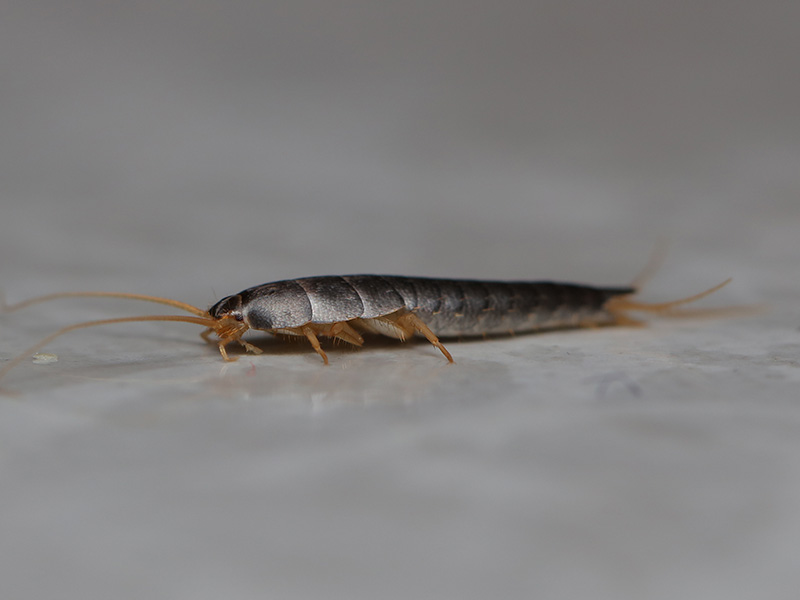
Silverfish have a distinctive look that's hard to confuse with other household pests.
Their speed makes them hard to catch—most people only see one for a second before it darts into a crack or behind a baseboard.
Silverfish are small, wingless insects with soft, scale-covered bodies. They feed on starchy materials found in many homes, including paper products, adhesives, fabrics, and some dry pantry goods.
They do not bite, sting, or spread disease. The issue is that they hide well, remain active in humid spaces, and can live for several years, allowing a population to build before a homeowner realizes what is happening.
Silverfish and firebrats are close relatives and look similar, but they favor different conditions.
In most Northeast Ohio homes, silverfish are far more common than firebrats. If you're finding small, fast-moving insects in the damp, cooler parts of your home, they're almost certainly silverfish.
Silverfish can show up in any Northeast Ohio home, though older houses tend to offer more of what they look for—especially through the humid summer months. A home is especially appealing when it has:
Silverfish don't show up because a home is dirty. They show up because the environment offers moisture, darkness, and something to eat—and most homes have all three.
Silverfish are good at staying out of sight. During the day, they tuck into tight spaces and come out after dark to feed.
Inside homes, silverfish often turn up behind baseboards, inside cardboard boxes and stacked papers, under sinks, around plumbing fixtures, in bathroom cabinets, in linen closets, between books on a shelf, behind wallpaper, in wall voids, and around stored clothing.
They may also appear in garages, sheds, and other outbuildings, especially when those spaces remain damp or hold items that sit undisturbed for long periods.
Outdoors, silverfish live in damp, sheltered areas under mulch, leaf litter, bark, rocks, and logs.
Silverfish won't threaten the structure of your home, but they can damage belongings, particularly things stored in basements, closets, and attics.
They feed on:
The damage usually shows up as small, irregular holes or surface scraping on paper and fabric. You may also see yellowish stains or tiny dark droppings that look like ground pepper near where they've been feeding.
Because silverfish are nocturnal, you can have an active population without ever seeing one in daylight. Watch for:
If you're seeing silverfish during the day on a regular basis, the population has usually grown large enough that the insects are being pushed out of their preferred hiding spots.
Because silverfish depend on moisture and food indoors, prevention comes down to making the environment less hospitable.
These steps can make your home less attractive to silverfish, but prevention alone will not clear an established population.
Silverfish are covered under all of Epcon Lane's residential pest control plans. Our ongoing quarterly pest treatments focus on the areas where silverfish are most active, addressing existing activity and helping prevent new infestations.
If you're finding silverfish—or noticing damage to stored belongings—our team is here to help. Epcon Lane has served homeowners in Akron, Cleveland, and Northeast Ohio since 1945. Give us a call to schedule an inspection or learn more about our pest control programs.
Two ways, mostly. Some are carried in — silverfish hitch a ride inside cardboard boxes, secondhand books, old paper, and packaging. Others crawl in on their own from outside, slipping through gaps around the foundation, utility lines, vents, and door or window frames.
Why do I keep finding silverfish in the sink or bathtub?
Silverfish can't grip smooth, vertical surfaces. They wander in looking for moisture, slip down the sides of a sink or tub, and can't climb back out—so that's often where you'll find them stranded in the morning.
Yes. They can survive for months without eating—sometimes a year or more—which is part of why they hang on in the quiet, out-of-the-way spots they favor long after you'd expect them to move on.
For most people, no. But the tiny scales and shed skins silverfish leave behind as they molt can act as allergens or asthma triggers for sensitive individuals, especially when a large population has built up in a bedroom, closet, or storage area.

Today was the first time Epcon Lane came out to service our home and John was awesome! He was very friendly, professional and personable. We're very happy with our decision to go with this company and can't wait for our future services!
Allie W.
Akron, OH

Matt was fantastic. Explained all options and was very thorough and friendly. Really like that they guarantee their work and will come back between spraying for any issues. These guys are top notch!
Jason L.
Cleveland, OH

I have always been pleased with the service I have received from Epcon Lane . Very effective and environmentally and pet conscious. Kermin truly addressed my needs yesterday . Seeing the new nest of yellow jackets and the carpenter ants starting to lay eggs . Gave the proper treatment and sent a very detailed message explaining everything. And wished me a good rest of my day. I am very appreciative!
Margaret G.
Akron, OH






Helpful Tips & Info